Introduction
Duplex steel fasteners join components in environments that would corrode or overload ordinary stainless hardware. Duplex stainless steel contains approximately equal proportions of austenite and ferrite. This dual-phase microstructure combines high mechanical strength with good corrosion resistance and toughness. The family covers Duplex Steel Bolts, Duplex Steel Screws, Duplex Steel Nuts and Duplex Steel Washers, each built to secure a joint under load. Oil and gas, chemical processing, marine engineering, pressure equipment and industrial piping all specify them where both strength and corrosion resistance matter.
What Are Duplex Steel Fasteners?
Duplex steel fasteners are threaded components made from duplex stainless steel, used to secure mechanical assemblies and industrial equipment. The combination of ferritic and austenitic microstructures gives them both mechanical strength and corrosion resistance, since the ferrite contributes strength and the austenite contributes toughness and corrosion performance. Engineers consider them for applications that bring corrosive environments and demanding mechanical loads together, where a single-phase grade would compromise on one or the other.
- High strength compared with many conventional austenitic stainless steel grades.
- Resistance to several forms of corrosion, depending on the grade and the service environment.
- Applications in industrial piping, pumps, valves and pressure equipment.
- Importance of matching the fastener properties to the required service conditions.
Duplex Steel Fastener Grades, Properties and Specifications
Two duplex grades cover most industrial fastener work, and the choice between them shapes mechanical properties, corrosion resistance, fabrication and application suitability. Grade selection is not a formality: it decides whether a fastener survives its environment and carries its load. The two grades below sit at different points on the strength-and-corrosion scale.
Duplex 2205 Fasteners
Duplex 2205 is commonly specified under UNS S31803 and UNS S32205 designations. Both belong to the 2205 duplex family, although S32205 has tighter compositional requirements for certain alloying elements. It delivers a minimum yield of around 448 MPa, roughly double common austenitic grades, with 21 to 23% chromium and 2.5 to 3.5% molybdenum behind its corrosion performance. The two designations carry related but not identical compositional requirements, with S32205 holding a tighter, higher nitrogen and chromium range, so the exact UNS matters when specifying.
Super Duplex 2507 Fasteners
Super Duplex 2507 is built for the most demanding environments, offering higher resistance to localised corrosion and greater mechanical strength than 2205. Super Duplex 2507 typically contains approximately 25% chromium and 6 to 7% molybdenum, with nitrogen contributing to its corrosion resistance. Its PREN generally exceeds 40, making it suitable for selected aggressive chloride environments. Its suitability still depends on the operating environment and the applicable product specification, since even a super duplex grade has limits that severe conditions can exceed.
Chemical Composition and Mechanical Properties
- Chromium, molybdenum and nitrogen as the important alloying elements driving corrosion resistance.
- Tensile strength and yield strength well above common austenitic grades.
- Elongation and hardness requirements set by the applicable specification.
- Corrosion resistance tied directly to the balanced duplex microstructure.
- Grade-specific material and product standards governing each designation.
Types of Duplex Steel Fasteners
Different fastener types connect, secure and support industrial components, and a joint is built from the shapes its design demands. The four core types cover the fastening, the engagement and the load distribution a connection needs.
1. Duplex Steel Bolts
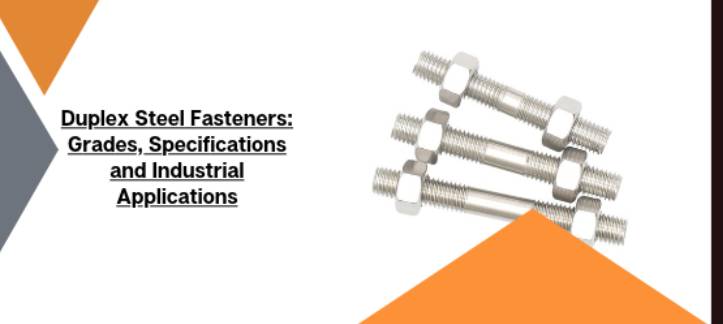
Duplex steel bolts cover hex bolts, stud bolts and other configurations used in mechanical assemblies and piping systems, carrying the main clamping load of a joint.
2. Duplex Steel Screws
Duplex steel screws include machine screws and other configurations suited to industrial applications, fastening components where a bolt-and-nut pairing is not used.
3. Duplex Steel Nuts
Duplex steel nuts work with compatible bolts and studs to form a secure joint, holding the clamping force the connection was designed around.
4. Duplex Steel Washers
Duplex steel washers distribute bearing loads and protect contact surfaces when properly selected, spreading the fastener load so it does not damage the joined faces.
- Fastener dimensions and thread types matched to the assembly.
- Compatibility between bolts, nuts and washers across the joint.
- Material grade and the applicable product specifications.
- Operating loads and the environmental conditions the joint meets.
For a broader view of the options, see these types of fastener materials.
Mechanical Properties and Corrosion Resistance of Duplex Steel Fasteners
The duplex microstructure drives both strength and corrosion performance, which is why these fasteners suit duties that defeat single-phase grades. Mechanical properties have to be read alongside the actual service environment, since a strong fastener in the wrong chemistry still fails.
- High yield strength compared with many conventional austenitic stainless steel grades.
- Resistance to pitting and crevice corrosion in suitable environments.
- Resistance to chloride-related corrosion, depending on the grade and the conditions.
- Suitability for selected marine and chemical-processing applications.
- Influence of temperature, stress, surface condition and chemical concentration on performance.
- Duplex steel is not immune to corrosion, so material selection requires an assessment of the operating conditions.
Industrial Applications of Duplex Steel Fasteners
Industries select duplex steel fasteners where the mechanical properties and the corrosion resistance both earn their cost.
1. Oil and Gas Industry
Oil and gas operations use duplex fasteners in selected piping systems, offshore equipment and process installations, where chloride exposure and mechanical load arrive together.
2. Chemical Processing Plants
Chemical processing plants use them in equipment exposed to compatible corrosive chemicals and process fluids, where the duplex grade resists attack that would pit austenitic hardware.
3. Marine Engineering
Marine engineering draws on duplex fasteners for suitable marine equipment, seawater-related systems and offshore applications, where salt and stress combine.
4. Pumps, Valves and Industrial Piping
Pumps, valves and industrial piping use duplex fasteners to secure flanges, equipment components and piping assemblies where the specified grade meets the service requirements.
We at NIKO Steel & Engineering LLP work with duplex fasteners across these sectors, and this guide sets out the grades, the specifications and the applications that decide which fastener suits a service.
Duplex Steel Fasteners vs Other Materials
Duplex steel fasteners sit between Super Duplex 2507 above and SS 316 and carbon steel below, separated by mechanical strength, corrosion resistance, cost and operating conditions. The table sets out how they compare.
| Comparison Factor | Duplex 2205 | Super Duplex 2507 | SS 316 | Carbon Steel |
| Material Type | Duplex (austenite + ferrite) | Super duplex (austenite + ferrite) | Austenitic stainless | Plain carbon steel |
| Mechanical Strength | High (yield ~448 MPa min) | Higher (yield ~550 MPa min) | Moderate (yield ~170 MPa) | Varies by grade |
| Corrosion Resistance | Strong in many environments | Strongest of the four | Good in milder service | Low without coating |
| Pitting and Crevice Corrosion Resistance | Good (PREN ~35) | High (PREN above 40) | Moderate (PREN ~24) | Poor |
| Typical Applications | Piping, pumps, valves, marine | Seawater, aggressive chloride service | Food, pharma, general industry | General structural, non-corrosive |
| Relative Cost | Moderate | Highest | Lower | Lowest |
| Selection Consideration | Balance of strength and corrosion | Severe chloride duty justifies cost | Milder corrosion within its limits | Where corrosion is not a concern |
These are general comparisons; actual performance depends on the exact grade, the product specification and the operating environment. The most suitable material is the one that meets the engineering requirements and the lifecycle cost expectations, not the strongest or the cheapest on the list.
Standards, Dimensions and Thread Specifications
Applicable standards and dimensional requirements have to be confirmed before ordering duplex steel fasteners, since a grade that fits one specification may not be covered by another.
- ASTM and ASME material and product specifications governing the grade.
- ASTM A193 for specified bolting materials and ASTM A194 for specified nuts, subject to grade coverage.
- Metric and imperial thread systems, matched across the joint.
- Bolt diameter, length, pitch, thread form and dimensional tolerances.
- Compatibility between the fasteners and the intended assembly.
- Material test certificates and traceability requirements.
- Not every duplex grade is covered by every bolting specification, so confirm the precise grade and specification before procurement.
Manufacturing, Quality Testing and Certification
Manufacturing and inspection processes verify that a duplex fastener meets its grade and specification before it reaches an assembly.
- Raw material verification and grade identification at intake.
- Forging, forming, machining and threading as the product requires.
- Heat treatment and processing controls where the specification demands them.
- Dimensional inspection and thread verification against the drawing.
- Chemical composition and mechanical testing to confirm the grade.
- Positive Material Identification, where required by the order.
- Material test certificates and material traceability back to the heat.
- Inspection, certification and testing requirements agreed to the purchase order and the applicable standards.
How to Select the Right Duplex Steel Fasteners
Matching the fastener specification to the application before procurement is what keeps a joint sound over its service life.
- Select the grade on the corrosion exposure and the mechanical requirements.
- Verify the operating temperature, pressure and loading conditions.
- Confirm the bolt, nut, screw and washer dimensions.
- Check the thread type, pitch and component compatibility.
- Review the applicable ASTM or ASME specifications.
- Request the relevant material certificates and inspection documentation.
- Evaluate supplier capability, lead times and product availability.
Fastener selection should account for the joint design, the installation requirements and the long-term service conditions together, since a fastener chosen on grade alone can still fail on fit or installation.
Buying Duplex Steel Fasteners from a Supplier
Industrial buyers evaluating a supplier or exporter should weigh material grade verification, product specifications, dimensional accuracy and documentation before committing an order.
- Confirm the product grades and sizes against the purchase specification.
- Verify the availability of the required bolts, screws, nuts and washers.
- Request material test certificates and traceability documents where applicable.
- Confirm the packaging, delivery schedules and export documentation for international orders.
Buyers exploring the range can review the Duplex Steel Fasteners product page to confirm grades and specifications against the application.
Conclusion
Duplex steel grades, their mechanical properties, their corrosion resistance and the governing product specifications together decide whether a fastener suits its duty. The correct selection depends on the operating conditions, the fastener dimensions and the applicable standards, not on strength or price alone. Readers exploring duplex options can confirm the grade and specification against the service on the relevant Duplex Steel Fasteners product page before procurement.