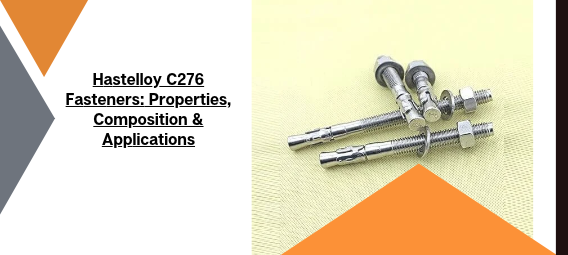
A single leaking flange in a sulphuric acid line can shut down a chemical plant for days. Hastelloy C276 Fasteners exist to prevent that failure. Built from a nickel-molybdenum-chromium alloy, they resist corrosion where stainless steel bolts pit, crack, or dissolve within months.
Chemical processing, offshore, oil and gas, power generation, pollution control, and pharmaceutical industries choose these fasteners over stainless steel because C276 survives in wet chlorine, hot sulphuric acid, and seawater, where grades like 304 and 316 fail fast.
This guide covers composition, mechanical properties, corrosion behavior, applications, grade comparisons, and selection criteria for Hastelloy C276 Fasteners.
What are Hastelloy C276 Fasteners?
Hastelloy C276 Fasteners belong to the nickel-molybdenum-chromium alloy family, built for environments combining oxidizing and reducing chemicals in one stream. Low carbon and silicon content prevent carbide precipitation during welding, so joints keep corrosion resistance without post-weld heat treatment. Manufacturing follows ASTM B574 for bars, ASTM B575 for plate, and ASME SB574 for pressure vessels, in Bolts, Nuts, Screws, Stud Bolts, Threaded Rods, Washers, Anchor Bolts, and U-Bolts sized M6 to M100 metric and 1/4 inch to 4 inches imperial per ASME B18.2.1 and ASME B18.2.2, produced under ISO 9001 systems.
Hastelloy C276 Chemical Composition
Nickel (57% min) forms the base matrix resisting oxidizing and reducing acids alike. Chromium (14.5-16.5%) resists oxidizing media like nitric acid and ferric chloride, while molybdenum (15-17%) drives resistance to pitting and crevice corrosion in chlorides; only a few nickel alloys carry this much. Tungsten (3-4.5%) adds localized corrosion resistance and high-temperature strength. Iron (4-7%) supports strength, cobalt stays under 2.5% to control cost, and manganese (1% max) plus silicon (0.08% max) stay low to avoid ductility-reducing phases. Carbon, capped at 0.01%, blocks chromium carbide precipitation at grain boundaries during welding.
Hastelloy Fastener Mechanical Properties & Temperature Resistance Chart
These figures, from ASTM B574, cover room-temperature strength and elevated-temperature limits.
| Mechanical Property | Value |
| Tensile Strength | 690 MPa min (100 ksi) |
| Yield Strength | 283 MPa min (41 ksi) |
| Elongation | 40% minimum |
| Hardness | 100 HRB maximum |
| Density | 8.89 g/cm³ |
| Modulus of Elasticity | 205 GPa |
| Temperature Property | Value |
| Max Continuous Operating Temp | 1093°C (2000°F) |
| Oxidation Resistance | Stable to 1000°C in air |
| Thermal Expansion | 11.2 µm/m·°C (20-100°C) |
| Thermal Conductivity | 10.2 W/m·K at 20°C |
| Melting Range | 1325°C to 1370°C |
Corrosion Resistance of Hastelloy C276 Fasteners
Sulphuric acid up to 60% at 65°C causes minimal attack, a window that would destroy a 316 stainless bolt within weeks. Hydrochloric acid resistance holds to 10% at ambient temperature, and phosphoric acid service extends across a wide range. Nitric acid is the exception: C276 handles dilute solutions reasonably, but hot or concentrated nitric acid calls for higher-chromium alloys such as Hastelloy G-30.
Chloride environments are where C276 is used a lot: wet chlorine gas, seawater, hypochlorite solutions, and ferric chloride all fall within its range, driven by molybdenum content. The alloy resists oxidizing and reducing chemicals in the same line, plus pitting, crevice attack, stress corrosion cracking, and intergranular corrosion.
Hastelloy Fasteners for Sulphuric Acid & Aggressive Chemical Environments
Chemical processing plants, fertilizer manufacturers, pickling operations, and petrochemical refineries push most fastener materials past failure within one cycle. C276 fasteners hold up across acid storage tanks, heat exchangers, scrubbers, reactors, pressure vessels, and chlorination plant piping.
A 316 bolt in 20% sulphuric acid at 50°C loses measurable thickness within months; C276 shows negligible attack at that same point, since its passive layer does not break down the way stainless steel’s chromium oxide layer does. Relying on nickel, molybdenum, and chromium together means fewer shutdowns and less joint leakage.
Applications of Hastelloy C276 Fasteners
Chemical Processing Plants: Reactors and piping handling mixed acid streams rely on C276 bolts.
Oil & Gas: Downhole tools exposed to sour gas and chloride brines use C276.
Offshore Platforms: Constant seawater spray makes C276 the standard for structural connections.
Marine Equipment: Propeller shafts and seawater piping specify C276 for saltwater duty.
Power Plants: Flue gas and cooling circuits use C276 against chloride corrosion.
Pulp & Paper: Bleaching towers depend on C276 for resistance to hypochlorite exposure.
Pharmaceutical Industry: CIP systems using aggressive sanitizers require C276 on closures.
Pollution Control: Scrubber internals exposed to acidic condensate use C276 fasteners.
Waste Treatment: Sludge digesters specify C276 against mixed acid streams.
Aerospace: Engine components exposed to combustion byproducts use C276.
Nuclear Industry: Fuel reprocessing equipment handling nitric acid uses C276.
Desalination Plants: RO skids rely on C276 against high-chloride seawater.
Hastelloy C276 Bolts for Flue Gas Desulphurisation (FGD) Systems
FGD systems employ a limestone slurry scrubber to remove sulphur dioxide from exhaust gas, integrating chlorides, acidic condensates and near-saturation moisture in a single loop. Slurry chloride levels >20,000 ppm attack stainless bolts causing pitting in the first year, requiring outage-driven replacement.
Hastelloy C276 Bolts resist this because molybdenum and chromium address both corrosion mechanisms at once. Scrubbers, absorbers, ducting, pumps, flanges, and pipe supports all benefit from the C276 specification, particularly at slurry splash zones and condensate drip points.
Hastelloy C276 vs C22 Fasteners: Which Grade for Extreme Corrosion?
Both share a nickel-molybdenum-chromium base, but their chromium-to-molybdenum ratio shifts performance toward different environments.
| Property | Hastelloy C276 | Hastelloy C22 |
| Chromium Content | 14.5-16.5% | 20-22.5% |
| Molybdenum Content | 15-17% | 12.5-14.5% |
| Oxidizing Media | Good | Superior |
| Reducing Media | Superior | Good |
| Chloride Resistance | Excellent | Excellent |
| Weldability | Excellent | Excellent |
| Temperature Capability | Up to 1093°C | Up to 1093°C |
| Cost | Slightly lower | Slightly higher |
| Typical Applications | Sulphuric/hydrochloric acid | Ferric chloride/mixed oxidizers |
C276 beats with strong reducing acids like hydrochloric or sulphuric acid, or streams cycling between oxidizing and reducing chemicals. C22 fits oxidizing environments such as wet chlorine with ferric contamination.
Hastelloy vs Inconel vs Monel: Choosing the Right Superalloy Fastener
Each nickel-based family suits a different mix of temperature and corrosion demands.
| Property | Hastelloy C276 | Inconel 625 | Monel 400 |
| Base Alloy | Ni-Mo-Cr | Ni-Cr-Mo | Ni-Cu |
| Corrosion Resistance | Excellent in acids | Excellent, high-temp oxidation | Excellent, seawater/HF acid |
| High-Temp Strength | Good | Superior | Moderate |
| Marine Performance | Excellent | Good | Superior |
| Oxidation Resistance | Good to 1000°C | Superior to 1093°C | Moderate |
| Cost | Moderate-high | High | Moderate |
| Common Applications | Chemical plants, FGD | Aerospace, turbines | Seawater valves, HF units |
Hastelloy suits mixed acid service, Inconel fits high-temperature turbines, and Monel remains standard for seawater valves and hydrofluoric acid units, where copper’s chloride resistance gives an edge nickel-chromium alloys cannot match.
Advantages of Hastelloy C276 Fasteners
Resistance across oxidizing and reducing media is the primary advantage, but not the only one. Hastelloy C276 Fasteners deliver a service life measured in years, cutting replacement frequency and shutdown costs. Tensile strength of 690 MPa and yield strength of 283 MPa exceed many stainless grades, and weldability without post-weld heat treatment simplifies fabrication. Chloride resistance eliminates pitting common in 316 stainless near coastal sites, while oxidation resistance to 1000°C extends thermal cycling duty.
How to Select the Right Hastelloy C276 Fasteners
Start with operating temperature and chemical exposure, since these decide whether C276 is even the right alloy before size matters. The bolt diameter, thread pitch and whether stud bolts or hex bolts are used on the flange are determined by the pressure rating and load requirements. Thread type must match exactly with the mating hardware. Mixing metric and imperial threads under pressure creates leak paths no alloy can fix.
Confirm compliance with the relevant standard, whether ASME B16.5 for flanges or API 6A for wellhead equipment, and request certification traceable to the heat number. Check surface finish for sealing and galling resistance and confirm that the manufacturer performs composition, tensile and dimensional testing on every batch, with mill certificates and third-party inspection for critical service.
Conclusion
Hastelloy C276 Fasteners hold up in corrosive, high-temperature environments that push stainless steel to failure within a single cycle. From sulphuric acid reactors to offshore structures to FGD scrubbers, the alloy’s composition resists pitting, crevice attack, and stress corrosion cracking that few other materials match. Match operating temperature, chemical exposure, and standards to your joint before finalizing a specification, and request certification to confirm traceability from mill to finished fastener.