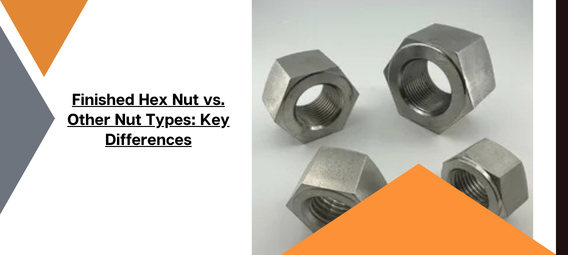
Finished hex nuts provide standard strength for general joints, while other nut types resist vibration, handle heavy loads, or allow hand-tightening. The finished hex nut remains the most widely used fastening component across industrial and commercial applications. Understanding how it compares with other nut types helps engineers and procurement teams make better specification decisions.
What is a Finished Hex Nut?
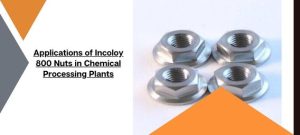
A finished hex nut is a six-sided, internally threaded fastening device, machined to near dimensional specifications on all bearing and seating faces. Finished hex nuts have machined bearing and seating surfaces that provide accurate dimensions and consistent load distribution. Application standard: ASME B18.2.2, ISO 4032 or DIN 934 for thread shapes.
Why Are Different Types of Nuts Used?
No single nut design handles every fastening scenario reliably. Vibrating machinery needs a nut that resists loosening under cyclic load. High-pressure fittings need more bearing surface than a regular hex nut can provide. Hand-tightened designs have the advantage of frequent disassembly. Carbon steel is not suitable for corrosive situations. Stainless, alloy, or coated steels are used. Each version considers unique shortcomings of the regular nuts.
Finished Hex Nut vs. Other Nut Types
Finished Hex Nut vs. Heavy Hex Nut
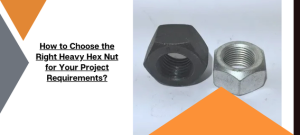
Heavy hex nuts are larger and thicker than normal hex nuts. These features allow the components to carry heavier weights and cover a broader surface area. Consequently, they are ideal for high-pressure applications like structural connections and pressure vessel flanges.
Finished Hex Nut vs. Lock Nut
Lock nuts are used on rotating machinery to resist loosening by vibration, using nylon inserts or distorted threads. Standard polished hex nuts do not possess this dominating torque attribute and are quicker and more inexpensive for static, low-vibration installations.
Finished Hex Nut vs. Jam Nut
Jam nuts are about half the thickness of regular hex nuts. They are not meant to take the main load. Instead, they operate as auxiliary lock nuts or give adjustment against primary nuts.
Finished Hex Nut vs. Flange Nut
Flange nuts have a washer-like base that is merged with the nut to spread the clamping force over a larger surface area. This design avoids pull-through on thin sheet metals without the need for a separate loose washer.
Finished Hex Nut vs. Cap Nut
Cap nuts have a domed top that conceals the exposed threads on a bolt, protecting it from corrosion and improving the appearance of visible machinery. They are not stronger than regular hex nuts, and they limit the amount of thread engagement.
Finished Hex Nut vs. Wing Nut
Wing nuts extend two large wings from the nut body for easy hand tightening without tools. They are suited for applications requiring frequent assembly and disassembly where clamp load requirements stay low. Battery terminals, instrument covers, and temporary mechanical connections use wing nuts for convenience. Any application requiring controlled bolt tension or high clamp load rules out wing nuts in favour of a standard finished hex nut tightened with a spanner.
Comparison Table
| Nut Type | Design | Load Capacity | Vibration Resistance | Installation | Typical Applications |
| Finished Hex Nut | Six-sided, machined | High | Moderate | Standard tools | General industrial fastening |
| Heavy Hex Nut | Wider, thicker | Very High | Moderate | Standard tools | Structural, pressure vessels |
| Lock Nut | Locking insert/thread | High | Excellent | Standard tools | Vibrating equipment |
| Jam Nut | Thin profile | Low–Moderate | Moderate | Standard tools | Secondary locking, adjustment |
| Flange Nut | Integrated flange | High | Moderate | Standard tools | Sheet metal, automotive |
| Cap Nut | Closed dome end | Moderate | Moderate | Standard tools | Decorative, thread protection |
| Wing Nut | Hand-tightened wings | Low | Poor | By hand | Frequent disassembly |
Also read: Difference Between Standard Hex Nuts and Heavy Hex Nuts
Advantages of Using Finished Hex Nuts
Hex nuts are tightened with a spanner or socket wrench. High clamping force without special tools. Hex nuts are available in carbon steel, alloy steel and stainless steel in 304, 316 and duplex for corrosive environments. They are the standard for general-purpose fastening, and are available in M4-M100 and ¼”-4″ inch sizes. Its cost per unit is lower than that of specialist nuts in the same strength classes and its compatibility with regular bolts and threaded rods makes multi-supplier procurement easier.
How to Choose the Right Hex Nut?
Match nut grade to bolt grade. A Grade 2 nut on a Grade 8 bolt creates a mismatched joint that fails at the nut threads before the bolt reaches its load limit. Select stainless steel hex nut grades for corrosive or food-contact environments; alloy steel for elevated temperature or high-strength applications. Verify thread form and pitch against the bolt specification; metric and unified inch threads are not interchangeable. Confirm compliance with ASTM A563, ASME B18.2.2, DIN 934, or ISO 4032 depending on the applicable project standard.
Conclusion
Finished hex nuts remain the preferred choice for most general industrial fastening applications because they combine strength, availability, and cost-effectiveness. Understanding when to specify alternatives such as heavy hex nuts, lock nuts, or flange nuts helps prevent joint failures in demanding operating conditions. NIKO Steel & Engineering LLP supplies the full nut range in carbon steel, stainless, and alloy grades with ASTM certification and export capability. Contact the team for specifications and current stock availability.