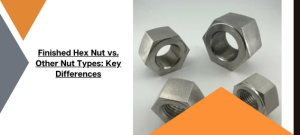
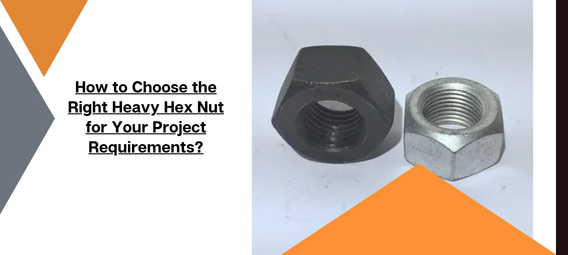
The heavy hex nut is engineered specifically for high-pressure and heavy-load applications, offering a larger bearing area, greater thickness, and higher proof load capacity than standard finished hex nuts. Selecting the correct heavy hex nut for a specific application requires evaluating material, grade, thread compatibility, environment, and applicable standards before placing a procurement order.
What is a heavy hex nut?
A heavy hex nut carries a wider width across flats and greater thickness than its standard finished hex nut equivalent at the same thread size. Increased material thickness raises both the proof load capacity and the bearing area. This expansion is critical in structural connections where bolt tension must withstand sustained and dynamic loads without thread stripping or joint loosening. Heavy hex nuts mate with ASTM A325 and A490 high-strength structural bolts and ASTM A193 stud bolts for pressure vessel and piping flange service. Dimensions are in inches ASME B18.2.2 and in metric (ISO).
Why Choosing the Right Heavy Hex Nut Matters
Thread stripping is the primary failure mode when the nut grade falls below the bolt grade. The nut threads yield before the bolt reaches its rated proof load, producing a joint that feels tight at installation but carries less than its designed clamp force. Dimensional mismatch between nut and bolt thread creates false torque readings during installation. Both failure modes are invisible until the joint loosens in service or separates under load, consequences that are significantly more expensive to address after installation than at the specification stage.
Factors to Consider When Choosing a Heavy Hex Nut
Material Selection
Carbon steel heavy hex nuts are suitable for general structural applications in mild environments. Stainless steel heavy hex nuts provide corrosion resistance in marine and chemical service. An Alloy Steel Heavy Hex Nut manufactured to ASTM A194 Grades 2H, 4, or 7 maintains the proof load capacity required for high-pressure and high-temperature piping applications.
Standards and Strength Grade
ASTM A194 is for nuts for high-pressure and high-temperature usage (Grade 2H for A193 B7 studs, Grade 7 for cryogenic duty), and ASTM A563 is for structural applications. It is important to match nut grades with bolt specs to ensure the system can handle the load capacity it is designed for.
Load and Pressure Requirements
Nuts for static loads shall be designed to proof load levels greater than the minimum tensile strength of the bolt. Dynamic and cyclic applications place fatigue demands on A193/A194 heavy hex nut combinations that require them to survive intense pressure cycling in high-pressure piping flanges.
Operating Environment
If it is an outside installation, the nuts should be hot dip galvanized or stainless to prevent early rust and deterioration. Corrosion-resistant alloys are required in chemical settings, and applications above 400°C require plain or alloy steel nuts without coatings to avoid breakdown of the zinc coating at high temperatures.
Thread Size and Compatibility
UNC threads are used for general structural demands. UNF threads provide a better clamping force. Metric threads are to ISO specifications. Thread size, pitch and shape must always be exactly the same. Never mix inch and metric components.
Surface Finish & Protective Coatings
Plain finishes are good for indoor or high-temperature applications, zinc plating for mild exposure, and hot-dip galvanizing for coastal installations. No coating should exceed thread tolerances and affect any assembly torque settings.
Compliance And Quality Assurance
Buyers should request EN 10204 Type 3.1 Mill Test Certificates together with dimensional inspection reports confirming compliance with ASME B18.2.2.
Common Applications of Heavy Hex Nuts
Severe service applications include structural steel construction, flanges for oil and gas pipelines, and pressure vessel nozzle assemblies. Similarly, petrochemical factories, power generation turbines and expansion joints for infrastructure often withstand severe dynamic stress. Hence, all these systems are provided with hefty hex nuts since regular finished hex nuts do not possess sufficient load capability.
Common Mistakes to Avoid When Selecting Heavy Hex Nuts
Marine environments will induce corrosion loosening of carbon steel nuts after three years. A563 Grade Not Mismatched: A strip of nuts before stud A193 B7 proof load. Incorrect thread specifications lead to project delays; incompatible coatings prevent assembly torquing. Nuts without MTCs that are not certified fail critical quality audits.
Choosing a Reliable Heavy Hex Nut Supplier
Choosing an experienced heavy hex nut supplier means working with a company that provides ASTM A194 and ASTM A563 compliant products alongside EN 10204 Type 3.1 Mill Test Certificates. Furthermore, they must offer comprehensive stock across grades and sizes with complete export documentation for EPC projects. NIKO Steel & Engineering LLP stocks A194 2H, 7, 4, and 8 grades. Along with structural heavy hex nut ranges with third-party inspection available and documentation packages that fulfill EPC project needs.
Conclusion
Selecting the right heavy hex nut, matched to the actual application in terms of material, grade, thread, and coating, is as important as selecting the right bolt. NIKO Steel & Engineering LLP supplies certified heavy hex nuts across carbon steel, stainless, and alloy grades with fast dispatch for both project and repeat orders. Contact our team to confirm availability and specifications.