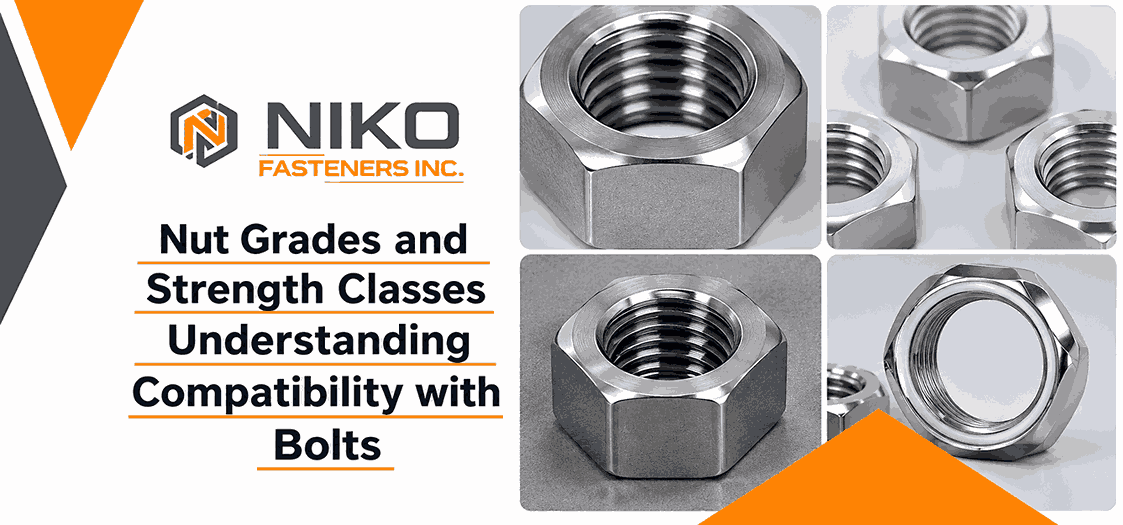
Nut grades and strength classes define the material and mechanical capability a nut brings to a bolted joint. Every clamped connection depends on the nut holding the preload without stripping or corroding. Specify a grade below the bolt’s capability and the thread fails first, often without warning. Service temperature, chemical exposure and the bolt strength class together decide the right choice.
What Are Nut Grades and Strength Classes?
Nut grades identify material composition, while strength classes state proof load and hardness. SS 304 and Alloy 625 are alloy names. HT 8.8 and HT 10.9 name mechanical performance, with the numbers tied to the tensile and yield values of matching bolts. A nut must meet or exceed the bolt’s proof load, or threads shear under torque. Operating pressure, media and temperature narrow the selection further.
Understanding Stainless Steel Nut Grades
Stainless Steel 304 & 304L Nuts
SS 304 and 304L resist atmospheric and mild chemical corrosion at low cost. The 304 / 304L Nut suits structural steelwork, food equipment and general industrial assemblies.
Stainless Steel 316 & 316L Nuts
Molybdenum lifts chloride resistance well beyond 304. The 316 / 316L Nut holds up in marine decks, chemical plants and coastal outdoor fixings.
Nickel Alloy Nut Grades for Corrosive and High-Temperature Applications
Alloy 20 Nuts
Alloy 20 withstands sulphuric acid attack and stress corrosion cracking. The Alloy 20 Nut serves chemical processing lines, acid tanks and pickling equipment.
Monel 400 Nuts
Monel 400 resists seawater, brine, and hydrofluoric acid. The Monel 400 Nut fits marine hardware, pumps, valves, and chemical handling assemblies.
Inconel 600 & 625 Nuts
Both grades hold strength past 600°C. The Inconel 600 Nut suits furnace and heat treatment work, while the Inconel 625 Nut adds pitting resistance for seawater and acid service.
Incoloy 800 & 825 Nuts
Incoloy resists oxidation and carburisation in hot process streams. The Incoloy 800 Nut fits heaters and steam generators; the Incoloy 825 Nut handles sulphuric and phosphoric acid.
Hastelloy C276 Nuts
Hastelloy C276 survives wet chlorine, hypochlorite and strong oxidisers. The Hastelloy C276 Nut anchors scrubbers, reactors and flue gas desulphurisation equipment.
Duplex, Super Duplex & Titanium Nut Grades
Duplex Steel S31803 Nuts
Duplex delivers roughly twice the yield strength of 304 plus chloride resistance. The S31803 Nut works across marine, chemical and oil and gas assemblies.
Super Duplex Steel S32750 Nuts
A PREN above 40 gives S32750 resistance to chloride pitting and crevice attack. The S32750 Nut suits offshore platforms, subsea and seawater systems.
Titanium Grade 2 & Grade 5 Nuts
Titanium weighs 40% less than steel and shrugs off chlorides. The Titanium Grade 2 Nut targets corrosion duty; the Titanium Grade 5 Nut carries higher loads.
High-Tensile Nut Strength Classes
HT 8.8 Nuts
Class 8.8 nuts carry a proof load matched to 8.8 bolts. The HT 8.8 Nut secures machine frames, flanged joints and general structural steelwork.
HT 10.9 Nuts
Class 10.9 raises proof stress for tighter preload. The HT 10.9 Nut suits heavy machinery, crane structures, press frames and high-torque assemblies.
Nut Grade vs Bolt Strength Class: How Compatibility Works
Nut and bolt must share thread form, pitch, and governing standard. Strength class controls load capacity; material controls corrosion behaviour. A 10.9 bolt needs a class 10 nut, and a duplex bolt needs a duplex nut.
| Bolt Requirement | Nut Selection Consideration |
| Standard-strength bolt | Select compatible standard nut |
| High-strength bolt | Use a nut with the required strength rating |
| Stainless steel bolt | Match suitable stainless steel nut grade |
| Corrosive environment | Select corrosion-resistant nut material |
| High-temperature service | Use a grade designed for the operating temperature |
How to Select the Right Nut Grade for an Application
Start with the bolt material and strength class, then work outward. Operating temperature rules out stainless above 540°C and pushes you toward Inconel or Incoloy. Map chemical exposure against the media, since chlorides attack 304. Confirm thread type and dimensions against ASTM A194, ASME, ISO 898-2 or the project specification. Insist on mill test certificates so every nut traces back to its heat number.
Applications of Different Nut Grades
- Oil and gas: Duplex and super duplex grades hold preload in sour, chloride-heavy wellhead service.
- Petrochemical: Inconel and Incoloy keep clamping force through thermal cycling in crackers and reformers.
- Chemical processing: Alloy 20 and Hastelloy resist acid attack that pits stainless within months.
- Power generation: Nickel grades fasten boiler, turbine casing and heat exchanger joints.
- Marine and offshore: 316, Monel and S32750 withstand seawater, splash zones and crevice corrosion.
- Construction: HT 8.8 and HT 10.9 deliver the preload structural connections need under cyclic load.
- Heavy engineering: Alloy steel high-tensile grades absorb vibration and shock in mill equipment.
- Aerospace and specialised engineering: Titanium cuts weight while holding strength in corrosive service.
Common Mistakes When Selecting Nuts
Buyers size nuts by diameter alone and skip the bolt strength class, which drops a class 6 nut onto a 10.9 bolt and strips the thread at target torque. Mixing materials invites galvanic corrosion, so a carbon steel nut on a stainless bolt rusts out fast. Standard nuts land in chloride plants, grades run past their temperature ceiling, and nobody opens the test certificate until the joint leaks.
Conclusion
Correct nut grades and strength classes keep a bolted joint tight across its full service life. Match the nut to the bolt on mechanical rating and material together. Stainless, nickel alloys, duplex, titanium and high-tensile grades each answer a different operating problem. Niko Fasteners stocks the complete Nut range in all these materials. Request grade and certification details before finalising your fastener specification.